

What Is Industrial-Scale Food Processing?
.jpeg)
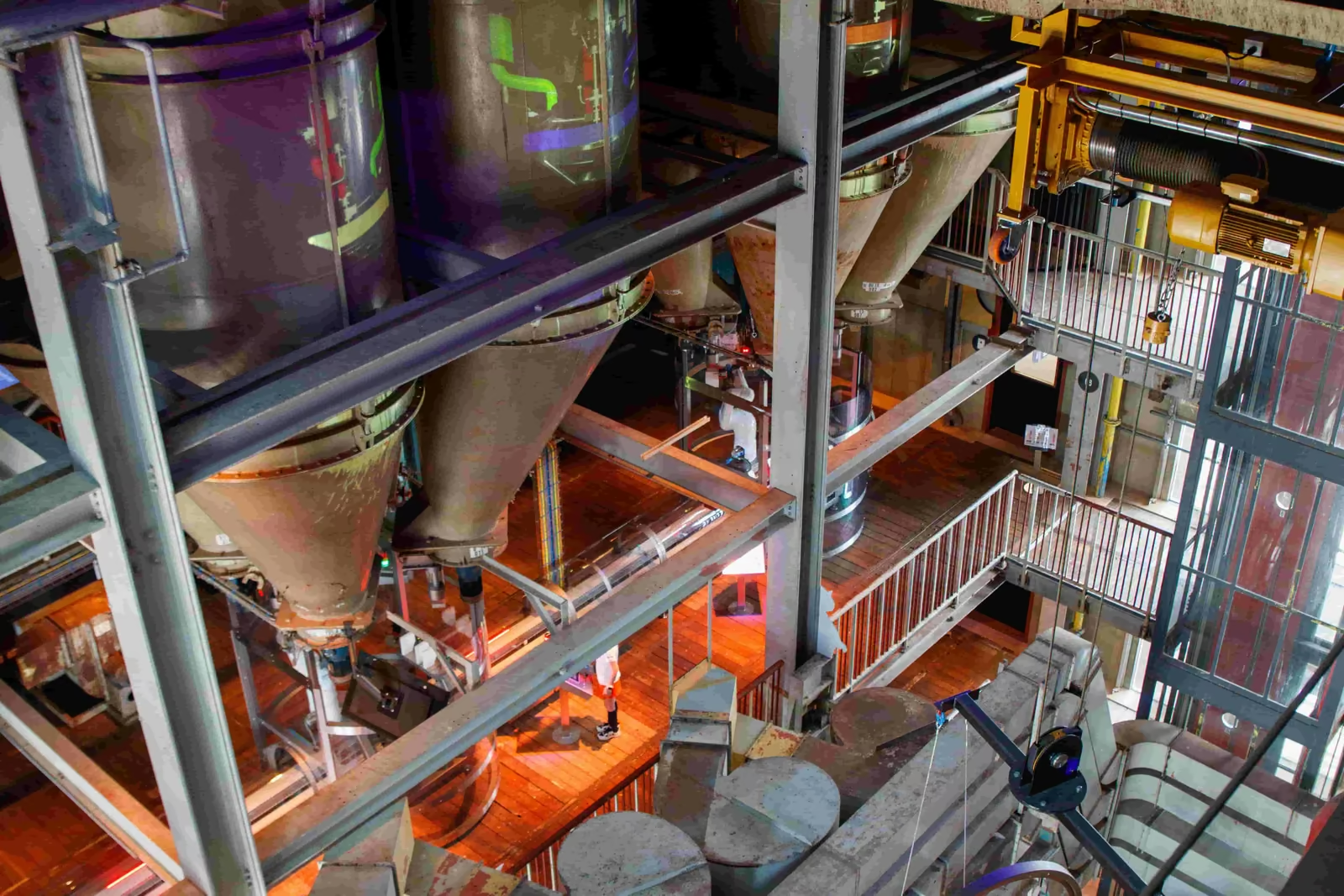
In as straightforward and simple terms as possible, industrial-scale food processing simply means the mass production of food products by converting raw ingredients into packaged, shelf-stable, or ready-to-eat goods without sacrificing safety and quality, with a shop floor comprising:
- Automated assembly lines
- Heavy machinery
- Standardized techniques
To achieve this, businesses in the food and beverage industry use machinery and tools to ensure every production run maintains consistent flavor and product quality from batch to batch, meets FDA and USDA regulatory requirements, and avoids material waste from over-committing or inconsistent portioning during a run.
In basic terms, that covers you for understanding what industrial-scale food processing is.
But let’s imagine you’re a baker and you make the best muffins in town, and you’ve just realized that it’s your money maker, and there’s a chance to start mass producing this for retail. You’d more than likely be thinking about scaling up food production for your muffins, and doing this while keeping costs low means following one or two manufacturing processes:
- Batch production
- Continuous production
Batch vs. Continuous Production
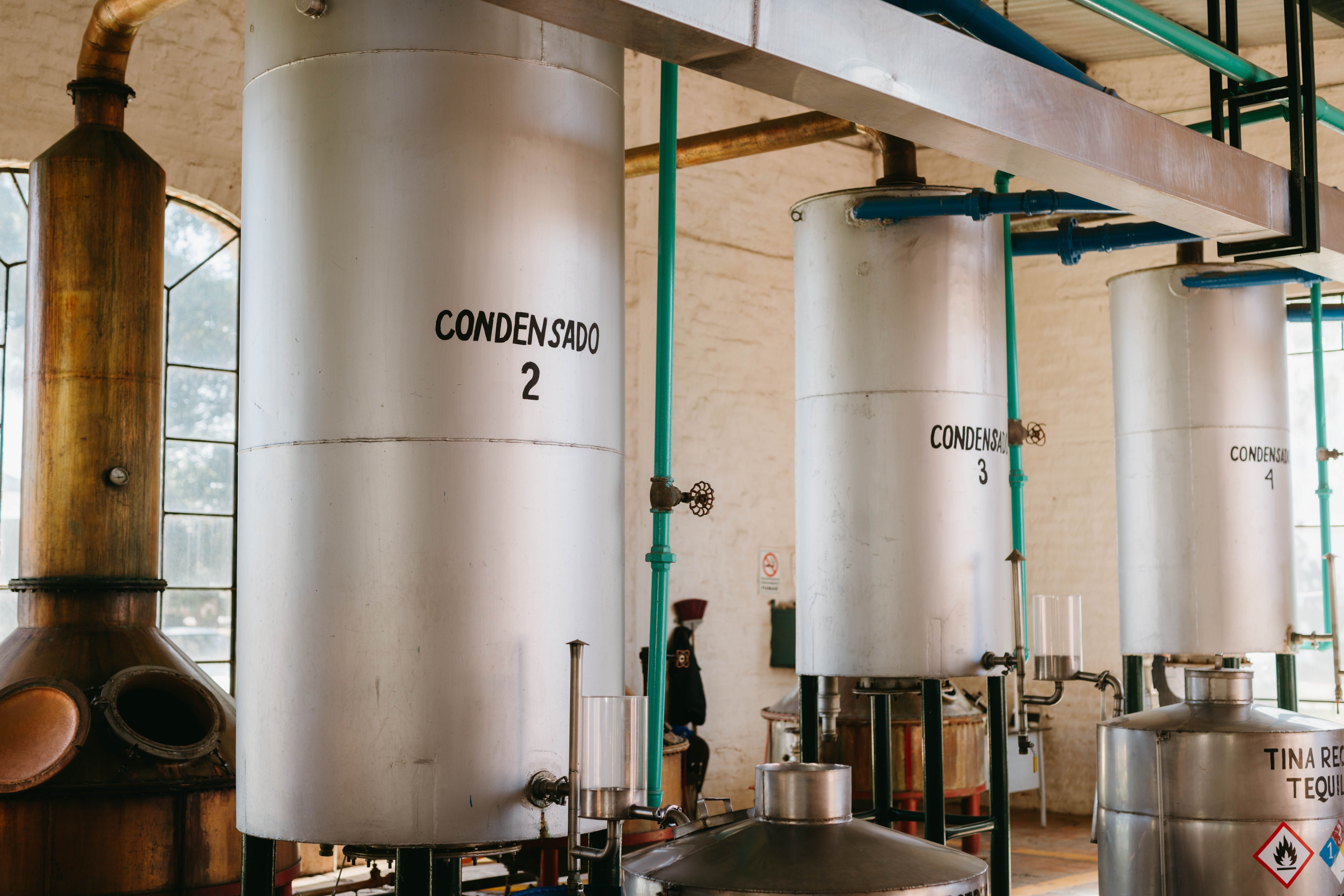
When a manufacturer wants to start mass-producing their food products, they’re going to be looking into doing this by implementing batch production manufacturing or a continuous manufacturing process (or perhaps both).
Which method is best for a manufacturer depends on a number of factors:
- The product's complexity
- The volume required
- The regulatory risk involved
Here is an explanation of both methods for industrial-scale food production.
Batch Production
If you’re following a batch production process, you’ll group a set of raw materials, move them through your manufacturing route, and produce a fixed quantity of product at the end. Once that batch has gone through the entire process, the next batch of materials is sent through.
Because of the stop-and-start nature of batch production, manufacturers usually take the time between runs to:
- Clean
- Inspect
- Set up
- Assign batch or lot numbers to each run
Batch production has a lower initial capital investment but requires more manual intervention and higher labor input per unit.
And the great thing about batch production runs is their flexibility: for each batch, you're not stuck producing the same exact product. For a muffin producer, each batch can be a different type of muffin, such as one with blueberries and another with chocolate chips, making this an ideal choice for businesses that make:
- Specialty sauces with seasonal recipe changes
- Allergen-segregated products
- Small-scale artisan goods
- Dairy and other short-shelf-life perishables
Or even those who are in early-stage product development or R&D and trying to find the best products for their audience.
Continuous Production
Continuous production, on the other hand, is what you imagine when you see assembly lines in a movie, with products shuffling along as our titular hero bobs and weaves between conveyor belts.
In this setup, raw materials enter the system or assembly line and pass through uninterrupted until they emerge at the other end as a finished product. A batch run might take a few hours to produce one lot of muffins. In continuous production, the equipment might be switched on and run for weeks or months (with maintenance breaks), with the entire cooking process automated.
Due to the amount of equipment that often needs to be custom-made for the business, the capital investment is a lot higher. However, if you can afford this investment, you get to enjoy lower labor costs per unit and greater output consistency, since steady-state operation minimizes the batch-to-batch variation seen in the other method.
Since this will only work if you’re creating one standardized product, like a vanilla muffin, let’s say, then this approach is best for making high-volume, commodity products like:
- Pasta and noodles
- Soft drinks and juices
- Snack extrusion and frying
- Vegetable oil processing
- Breakfast cereal manufacturing
But, to make the differences easier to understand, here is a side-by-side comparison of batch and continuous production for scaling up food production:
How to Scale Up Food Production: 9 Steps
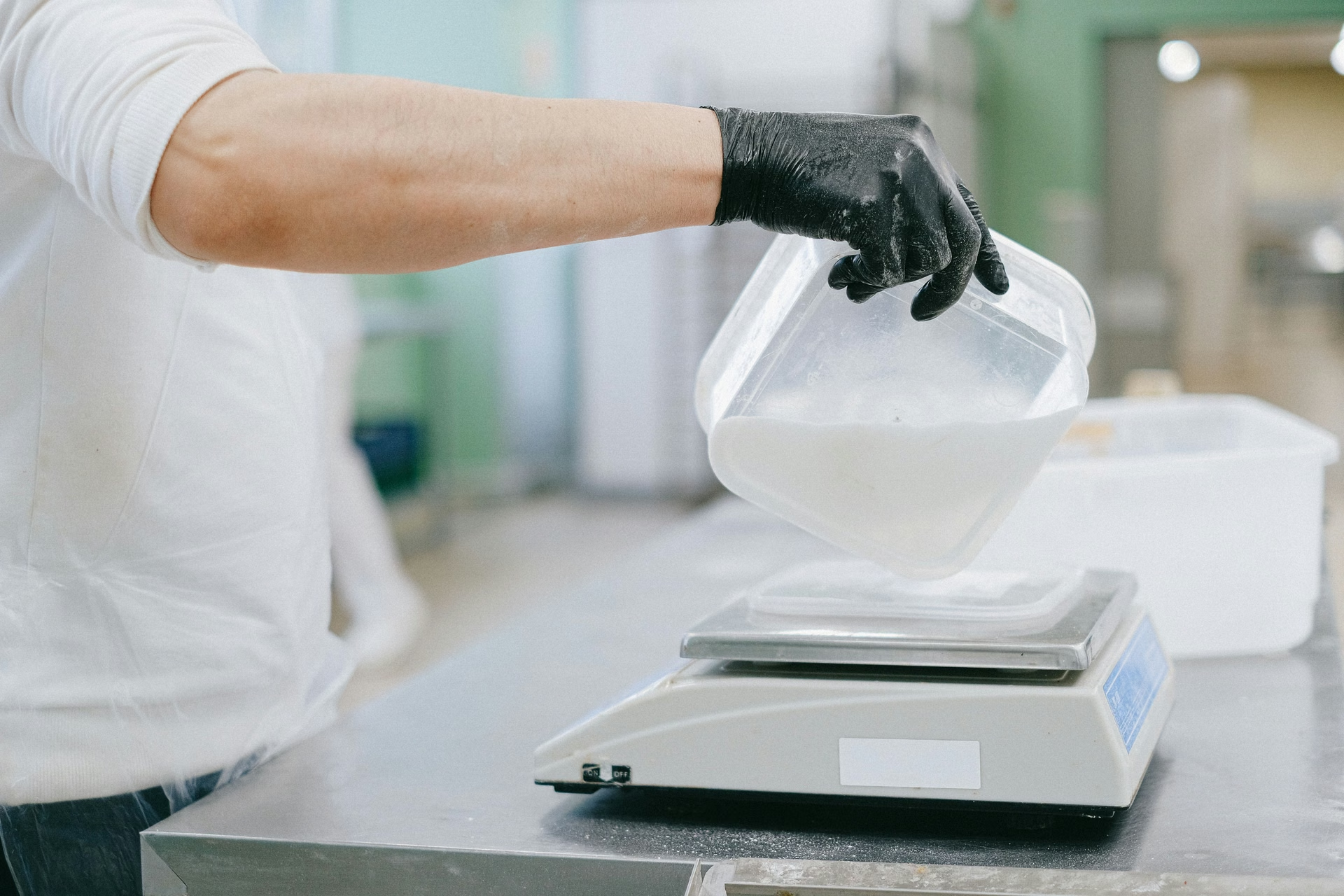
Visual input: Worker reviewing a spec sheet or batch record on the plant floor.
So, you know about the manufacturing processes that are going to help you start scaling up food production from a stove-top or small kitchen to industrial-scale volumes.
To properly achieve this, it’s worth mentioning that scaling up to these volumes is not just a matter of adding more or bigger equipment. Industrial-scale food production changes the underlying physics and economics of production. That’s why we decided to help you out by covering how to scale your food production effectively, with steps that will look into implications like:
- Technical
- Operational
- Safety
1. Define Product Specifications and Acceptable Ranges
First things first, dust off your recipes or your bills of materials and figure out what needs to change to achieve a new formula that makes sense at scale.
For example, if you’re making beverages, you need to consider your:
- Chemical specifications like pH and Brix
- Physical properties like color and viscosity
- Biological limits, such as yeast, mold, and total aerobic bacteria counts
The larger the volume in which your drinks are being manufactured and brewed, the more likely it is that the ratios you have been using before might not work in bigger batches.
Scaling a formula from 10 pounds to 2,000 pounds isn't a matter of multiplying ingredient quantities.
Ingredients can behave differently at volume. For example, an ingredient that was affordable at a small scale may blow the budget at a large scale, and units of measurement shift from teaspoons and cups to pounds and gallons.
Converting the recipe to exact weights or baker's percentages, mapping it as a flow diagram, and defining acceptable ranges for pH, moisture, and microbial limits turn the recipe into an engineered process rather than a guess.
Although some variability between batches is normal, the tricky part is determining how much is acceptable before it affects safety, quality, or taste. Brewing a small batch means losing less, but at scale, a bad batch can be costly, especially in an assembly-line setup.
So, it’s advised to sit down and define what a good final product should look like.
2. Reassess Ingredient Sourcing and Procurement
In the excitement of scaling up food production for your business, you need to remember that you’re essentially now running an entirely different business.
For example, perhaps your storage space was quite spacious with a 5-gallon pail, but that extra space you once had will quickly vanish when you’re suddenly ordering a 50-gallon drum instead — soon you’ll need to look into a warehouse. Another thing you need to consider is whether your current supplier can scale with you. Maybe you're an artisan baker who relies on specialty ingredients. Is your existing supplier going to be able to fulfill your larger purchase orders when you go from ordering 10 raw wasabi roots to 100?
At scale, profit margins usually decrease, and ingredient prices matter even more.
So, even if your current supplier can keep up with orders, are they offering the best price? Ultimately, if you want to start scaling up food production, you're pretty reliant on your supplier and prices, so be prepared to shop around or go back to step one if the ingredient costs aren’t justifiable.
3. Select Equipment for Mixing and Heat Treatment
Speaking of costs, if you thought your gas bill was high running a couple of stoves, try stomaching the bill when running an assembly line with a furnace blasting 24/7.
Both mixing the ingredients and heating them into a food product are going to jump up massively as you start to scale your production. And not only that, how the ingredients are mixed and heated is a problem too, as it’s way more difficult to evenly mix and heat food in a 100-gallon tank than in a 20-quart stockpot.
When choosing your equipment, you’ll need to pay close attention to the type of mixer you buy, as it depends on your product's viscosity, whether it needs folding or shear mixing, and whether solids are being incorporated. And simulating your commercial heat treatment (pasteurization or sterilization) at a small scale beforehand helps catch flavor, texture, color, or nutritional changes before they show up in a full production run.
4. Automate Material Handling and Product Transfer
Another thing that can be a shock when you’re finally trying to get your production line up and running is the size of your ingredients.
Before, you might have been dropping a knob of butter into a frying pan. Now you’re lifting a 50-pound block of butter over your head, up a ladder, and into a big churning tank of ingredients. What was once a two-second job is now something that requires pumps and piping for liquids, conveyors or mechanical lifts for solids, and heavy-duty mixing vessels for viscous or semi-solid ingredients — replacing manual transfer at volume.
Another thing that might come as a surprise is that ingredients don’t just occupy a corner of a table or a bowl — now they come with their own staging and storage areas for pre-treated ingredients.
5. Build In Food Safety Kill Steps and Scale-Appropriate Sanitation
A kill step (cooking, pasteurizing, or a pathogen-killing wash) has to be validated at your new production volume, since a missed or under-treated step can trigger a food recall.
Sanitation also becomes more complex at scale.
Cleaning a 20,000-gallon tank by hand is not practical, and an undersized clean-in-place system will cost you production hours, while an oversized one wastes capital and utilities. The facility itself (wall and floor materials, drain design, air handling) needs to withstand more aggressive cleaning regimes and the added heat generated by larger batches in the room.
6. Optimize Facility Layout and Workflow
Create separate, logical zones to reduce the risk of cross-contamination and unnecessary movement of product and staff, making it easier to scale production and:
- Prep
- Cook
- Package
Easy access to ingredients and equipment, along with clear pathways, keeps workflow efficient as volume increases and prevents the layout itself from becoming the bottleneck.
7. Minimize Yield and Production Loss
Losses during scale-up trials are often higher than anticipated, as the first and last portions of a batch are often discarded.
This typically decreases as batch sizes grow and the process is refined. Beyond trial losses, ongoing yield can be recovered through vessel design (scrape agitation, pressure, or vacuum systems for thick products), line evacuation methods for product left in transfer lines (air purge, water push, pigging), and finding secondary uses for waste streams like whey from cheese production, for example, which is a valuable product in its own right.
8. Use Simulation and Data Instead of Trial and Error
Optimizing a new process through pure experimentation is expensive, as every trial run consumes:
- Raw materials
- Labor
- Facility time
Predictive modeling software, which larger companies use to answer questions about equipment sizing, bottlenecks, and heating or cooling efficiency before committing to a full run, is increasingly available to smaller companies through consulting firms. Answering as many of these process questions as possible in simulation reduces both the cost of experimentation and the risk of a costly production mistake.
9. Decide Between In-House Equipment and a Co-Packer, Then Train and Pilot
Before investing in your own process equipment, it's often more prudent to work with a contract manufacturer, or co-packer, until the product has a proven sales track record. Evaluate co-packers on cost, production history, and experience with similar products, and confirm they'll sign a confidentiality agreement to protect your recipe.
Whichever path you take, train staff on batch procedures, equipment operation, and food safety protocols, and run scale-up trial samples through shelf-life testing and customer feedback before committing to a full commercial launch.
And finally, once you have found a contractor to work with as you build up your own facilities, make sure you’re investing in an MRP system that can keep up as you’re scaling up food production.
Managing Industrial Food Processing with Digit

Executing the steps above manually is where scale-ups lose time and effort, and shrink their profit margins, all because they choose to:
- Track specs in spreadsheets
- Update recipes by hand
- Chase down vendor information and batch data across disconnected systems
That’s why businesses turn to solutions like Digit, software that consolidates inventory, purchasing, and production into a single, connected platform built to help you with scaling up food production.
Recipe and BOM management with version control means the re-engineered formula from your scale-up work stays consistent across every production run, with cost tracked automatically as ingredient quantities and suppliers change. Purchase order management gives visibility into procurement as sourcing shifts from small quantities to bulk, so reorder points and supplier lead times are tracked rather than guessed at.
End-to-end traceability replaces the batch-number paper trail with live data: every lot is tracked from receiving through to finished goods, with barcode scanning recording movement in real time. That matters most when a kill-step or quality issue needs to be traced back to a specific input, since isolating the affected batch takes seconds rather than a manual records search.
Want to see for yourself how Digit can help you get more control over your business as you scale your operations? Head over to our website and book a call with us, and we’d be more than happy to show you how Digit can assist you as you start scaling up your food production.
.jpg)